---
title: "The Better AI Strategy: Extend Before You Replace"
description: 95% of AI pilots deliver no measurable P&L impact. The fix usually isn't a rebuild. How to extend the systems you already own, and what to extend first.
image: https://www.feature23.com/hubfs/raw_assets/public/f23-2025/images/og-image/f23-outperform.jpg
---
[Skip to main content](https://www.feature23.com/insights/ai-strategy-extend-before-you-replace#main-content)
[![feature\[23\] white and gold logo](https://www.feature23.com/hubfs/f23-logo-white-with-gold.svg "feature[23] white and gold logo")](https://feature23.com)
- [AI Engineering](https://www.feature23.com/ai-engineering)
- [Services](https://www.feature23.com/services)
- [Careers](https://www.feature23.com/careers)
- [Our Work](https://www.feature23.com/case-studies)
- [Insights](https://www.feature23.com/insights)
- [Contact us](https://www.feature23.com/Contact)
- [linkedin](https://www.linkedin.com/company/feature23)
- [Instagram](https://www.instagram.com/feature23)
- [twitter](https://twitter.com/feature23)
- [Privacy Policy](https://www.feature23.com/privacy-policy)
[Skip to content](https://www.feature23.com/insights/ai-strategy-extend-before-you-replace#main-content)
[![feature\[23\] white and gold logo](https://www.feature23.com/hubfs/f23-logo-white-with-gold.svg "feature[23] white and gold logo")](https://feature23.com)
- [AI Engineering](https://www.feature23.com/ai-engineering)
- [Services](https://www.feature23.com/services)
- [Our Work](https://www.feature23.com/case-studies)
- [Insights](https://www.feature23.com/insights)
- [Careers](https://www.feature23.com/careers)
- [Contact](https://www.feature23.com/contact)
# The Better AI Strategy: Extend Before You Replace
[Mike Potts](https://www.feature23.com/insights/author/mike-potts) Aug 18, 2026, 10:19:06 AM
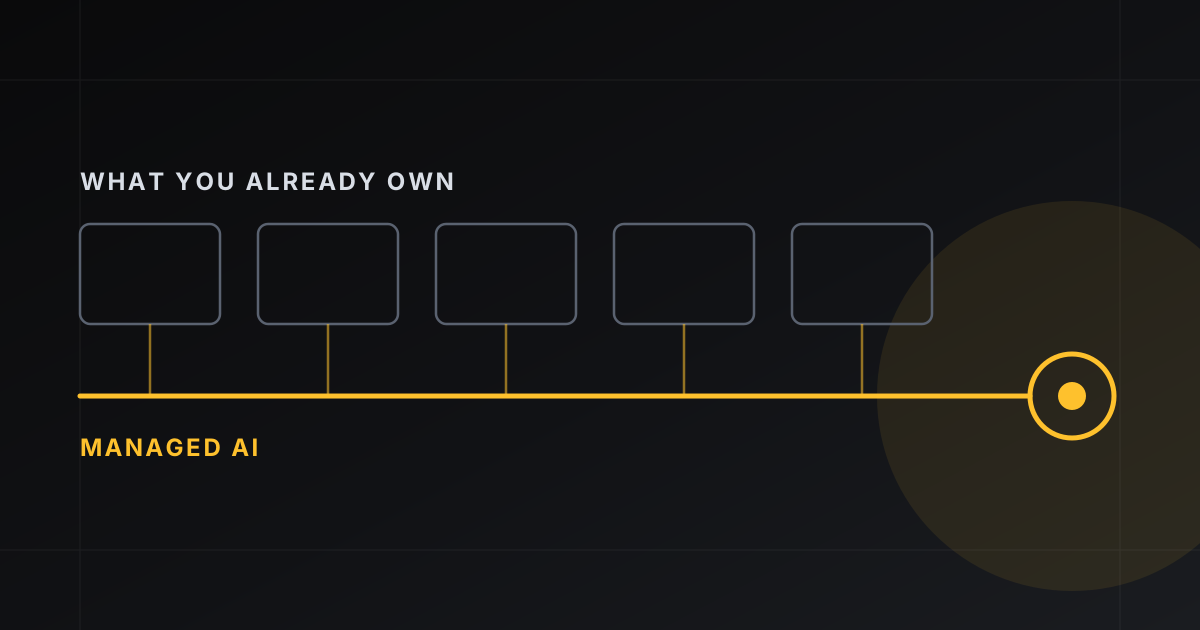
I keep ending up in the same conversation. An executive team has been shown a slide deck by somebody selling a rebuild, and the message is always the same: your technology is too old for AI, so you'll need to start over. Rip it out, build it again, this time the modern way.
That advice is wrong more often than it's right, and it's expensive in a way that doesn't show up until the following year. Most of the companies I work with are sitting on systems that already run their business well. The systems just can't be reached by anything other than a person with a login.
That's a different problem than being obsolete. And it costs a fraction as much to fix.
Key Takeaways
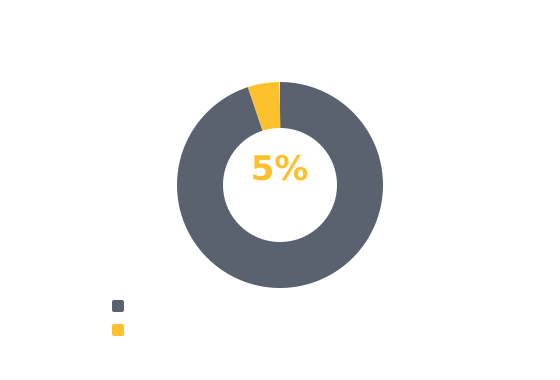
- →Roughly [95% of generative AI pilots produced no measurable P&L impact](https://mlq.ai/media/quarterly_decks/v0.1_State_of_AI_in_Business_2025_Report.pdf) after $30 to $40 billion in enterprise spend. The pattern behind the 5% that worked was integration into a specific workflow, not better technology.
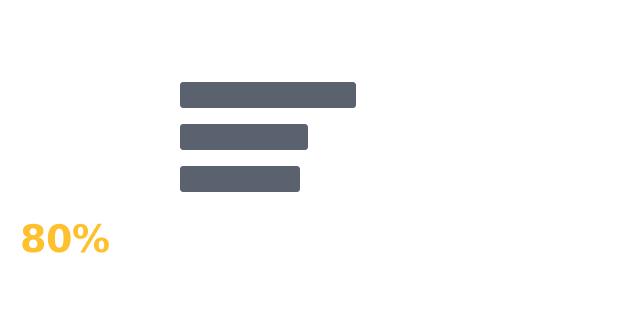
- →The constraint is usually access, not data quality. [80% of enterprises say AI is held back by limited data access](https://www.cloudera.com/about/news-and-blogs/press-releases/2026-04-14-nearly-80-percent-of-enterprises-say-ai-is-held-back-by-data-access-challenges-cloudera-report-finds.html), while only 22% name data quality as a barrier to ROI.
- →Your team is already connecting AI to company data, just without permission. [45% of employees are regular AI users on corporate devices](https://www.verizon.com/business/resources/reports/dbir/), and 67% of them use non-corporate accounts.
- →The way to pick what to extend first is to start from a business goal and work backward, which is exactly what impact mapping is built to do.
## Do You Have to Rebuild Your Software to Use AI?
No. A 2025 review of more than 300 public AI initiatives, 52 organizational interviews, and 153 executive surveys found [around 95% of generative AI pilots delivered no measurable P&L impact](https://mlq.ai/media/quarterly_decks/v0.1_State_of_AI_in_Business_2025_Report.pdf), against $30 to $40 billion in enterprise spend.
Read that number the wrong way and you conclude AI doesn't work. Read it the right way and you notice something more useful. The researchers found the failures weren't about model quality. They were about tools that sat outside the actual work, improving individual productivity without ever touching a business process. The initiatives that landed were deeply integrated into specific workflows.
That's not an argument for a new stack. It's an argument for reaching into the stack you have.
## Why "Start Over" Is the Wrong First Move
Our average client runs somewhere between 40 and 50 digital assets. Rewriting all of them so they can talk to an AI model isn't a strategy. It's a budget nobody has, spread across a timeline nobody will tolerate.
Think about what those systems actually contain. Twenty years of operating decisions, encoded. The pricing exception your ops team worked out in 2014. The dispatch logic that accounts for how your busiest branch actually schedules crews. That accumulated business logic is the expensive part, and it's the part a rebuild puts at risk.
There's also a question worth asking about where the advice is coming from. The firms most confident that you need to replace everything are usually the ones selling the replacement.
Key Insight
"Legacy" and "load-bearing" aren't the same thing, and confusing them is how good systems get thrown out. Age isn't the disqualifier. Inaccessibility is. A fifteen-year-old application with a clean way in is more useful to you right now than a new one nobody can query.
The honest math is that extension gets you to a business outcome in weeks, on a budget that doesn't require board approval, without pausing everything else on your roadmap. A replacement program does none of those things, and it defers every bit of AI value until after it lands. If it lands.
I've written before about how [build versus buy](https://www.feature23.com/insights/build-vs-buy-software) applies here. The same discipline holds. Build and rebuild what makes you hard to compete with. For everything else, find the cheaper path.
## What Does It Actually Mean to Extend a System With AI?
It means giving an AI model a governed way to read from and act inside the systems you already run. The standard most teams have converged on is the Model Context Protocol, and it's moved fast. [Nearly half of software organizations now run MCP servers in production](https://stacklok.com/resources/state-of-mcp-in-software-2026/), with 19% in broad production.
Here's the plain version. MCP is a common adapter between AI tools and the systems that hold your data. Instead of building a bespoke integration for every combination of model and application, you expose a set of actions once, and any compliant AI client can use them.
The distinction that matters to an executive is this one: you are not handing your data to an AI company. You're letting an AI tool call your systems, under your permissions, through your existing access model, with the calls logged. Someone who can't see payroll in the application still can't see payroll through the model.
### What this looks like on a real stack
Nobody I work with has a clean stack. The realistic picture is something proprietary that runs the core of the business, something standard like a CRM or ERP, and a decade of integrations holding it together. Extension works across that mix, which is exactly why it beats replacement. You don't have to normalize your portfolio before you can get value out of it.
The work itself is narrower than people expect. Identify the handful of actions that matter for one workflow. Expose them as tools. Put them behind the authentication the system already uses. Log everything. A purpose-built operations platform makes an especially good first candidate, since the business logic is already yours to expose. We built [exactly that kind of platform for Exceptional Case Services](https://www.feature23.com/case-studies/exceptional-case-services-custom-operations-platform).
## Is Your Data Really Not Ready for AI?
Usually, no, and this is where a lot of initiatives quietly die. A 2026 survey of 1,270 IT leaders found [80% say AI is constrained by limited data access](https://www.cloudera.com/about/news-and-blogs/press-releases/2026-04-14-nearly-80-percent-of-enterprises-say-ai-is-held-back-by-data-access-challenges-cloudera-report-finds.html), while only 22% named data quality as a barrier to ROI. Access is the bottleneck. Cleanliness is mostly an alibi.
"Fix the data first" sounds responsible. In practice it starts a program with no end date, because data is never finished, and the AI work stays permanently one phase away.
The deeper pattern is one I've watched sink initiatives that had nothing to do with AI. Companies plan against the business they wish they were instead of the business they actually are, then miss. You have a current state. Its quality is not a precondition for getting value out of it. You have to accept what you're working with and build from there, because aiming at an idealized version of your company is how you set yourself up to fail.
Is that universally true? No, and I'd rather say so. If there's no system of record, if the data lives in individual spreadsheets on individual laptops, if there's no access control worth the name, then the foundation genuinely isn't there yet. That's a real answer for a small number of companies.
For everyone else, you don't need clean data everywhere. You need one workflow where the data is good enough to be useful. Start there.
## Your People Are Already Doing This
They are, and the version they've built is the one that should worry you. In 2026, [45% of employees were regular AI users on corporate devices](https://www.verizon.com/business/resources/reports/dbir/), and 67% of them used non-corporate accounts. Somebody wants a report your system won't produce, so they open a personal AI account and point it at the application. The work gets done, nobody logs it, and the data leaves through a door your IT team doesn't know exists.

We used to call this shadow IT. Same instinct, much worse blast radius. We unpacked why people climb to that rung, and what the workaround is telling you about your systems, in [Shadow AI Is a Workaround. Your Software Is the Reason.](https://www.feature23.com/insights/shadow-ai-workaround)
Extending your systems properly is what converts that into something you can govern. Same productivity, running through sanctioned tools, inside your permission model, with an audit trail. Here's the part I'd underline for any CFO: the cost of extending AI is lower than most leaders assume, and the cost of not extending it is already being incurred. It's just landing on your risk register instead of your budget.
## How Do You Decide What to Extend First?
Start from a business goal and work backward to the system. Never the other way around. This sounds obvious and almost nobody does it, which is why so many companies end up with an impressive demo and no measurable outcome.
The obstacle isn't willingness. It's that most executives can't picture what's now possible, so they can't form the request. I've stopped waiting for a well-shaped ask, because it isn't coming.
Key Insight
I think we're having a Roman arch moment. The arch existed before Rome. Concrete existed before Rome. What Rome added was a version of concrete that didn't require a master craftsman, and once ordinary builders could use it, people built things their predecessors couldn't have imagined. We're at the same point. The capability is sitting there and most people can't yet see what to do with it. The ones who figure out how to think with these tools are going to build things the rest of the market won't see coming.
Impact mapping is the technique I use to close that gap. It comes from [Gojko Adzic's book of the same name](https://gojko.net/books/impact-mapping/), and it forces four questions in order:
- **Goal.** What measurable business outcome are we chasing? Not "use AI." Something like reducing quote turnaround from three days to one.
- **Actors.** Who can move that number? Estimators, dispatchers, branch managers, customers.
- **Impacts.** What would those people need to do differently for the goal to move?
- **Deliverables.** What could we build that causes that behavior change?
Run that on a whiteboard for an afternoon and the extension candidates surface on their own. You'll find the workflow where somebody re-keys data between two systems every Tuesday. You'll find the report that takes four days because it requires three people to log into three applications.
You'll also screen out the ideas that only look good in a demo, which is the real value. Most of my clients didn't ask for what we eventually built, because they didn't know to ask. We applied impact mapping, showed them what their existing platform could do once it was reachable, and the reaction was the same every time. Nobody knew that was on the table.
### The question that reframes the room
Instead of asking where you should use AI, ask what your people would stop logging in to do. That question maps directly onto extension work, and it produces a much better list. It's the same reason [most mid-market software projects fail before anyone writes code](https://www.feature23.com/insights/why-mid-market-software-projects-fail), and why starting from the goal matters so much.
## What Changes When AI Becomes the Interface?
People stop opening applications and start asking for what they need. I have a client whose leadership hasn't logged into their project management system in about six months. Every morning starts in an AI session that pulls project status, parses email for anomalies, and assembles a picture across roughly ten systems. Not because they're an early adopter by temperament. Because it's faster.
Nobody wants to log into thirty tools. They want their tools connected to one place they already work.
Now, the calibration. The average employee at the average mid-market company is not there yet, and I'd be selling you something if I claimed otherwise. But the comparison I keep coming back to is typing. It was a specialist skill until the hardware made it ordinary, and then it became a baseline expectation nobody thinks about.
What that means for a decision you're making in 2026 is straightforward. Systems an agent can reach stay useful. Systems that can only be reached through their own interface get worked around, then resented, then replaced. An older application with a well-designed way in is more future-ready than a newer one without one. This is an argument about accessibility, not about age.
## Where to Start Before Your Next Budget Cycle
Pick one workflow, extend one system, measure one business outcome. Your first extension is research, not a platform commitment, and treating it that way keeps the decision small enough to actually make.
A short readiness check you can run this week:
- Does the system have an API, or a database you control?
- Is there a documented access model you'd be comfortable putting behind a tool?
- Is there one workflow where a person moves data between systems by hand every week?
- Can you name the number that would move if that workflow got faster?
Four yeses means you have a candidate. Then the sequence is: impact map the goal, pick the narrowest workflow that touches it, extend that system, instrument the outcome, and decide what's next from evidence instead of a slide. If the honest answer to the first two questions is no, that's a debt problem before it's an AI problem, and [quantifying that debt for your board](https://www.feature23.com/insights/technical-debt-custom-software-middle-market-guide) is the better place to start.
Q4 is when most of our clients set next year's technology budget, which makes this the window where extend-versus-replace actually gets decided. The trap I'd warn against isn't picking the wrong first extension. It's spending a year on a readiness program and arriving at the next budget cycle with nothing to show for it.
## Let's Talk It Through First
Same offer as always. If you're weighing this and want to pressure-test the thinking, I'll get on a whiteboard with you. No contract, no invoice. An hour spent mapping the goal is worth more than a quarter spent scoping the wrong build. Start here: [feature23.com](https://feature23.com).
## Frequently Asked Questions
### What is MCP in plain terms?
The Model Context Protocol is a common adapter between AI tools and the systems that hold your data, so you build each connection once instead of once per model. [Nearly half of software organizations](https://stacklok.com/resources/state-of-mcp-in-software-2026/) already run MCP servers in production. Access still runs through your existing permissions.
### Is this secure enough for a regulated business?
Yes, when it runs through your existing access controls with full logging. Security is [the top adoption obstacle teams cite, at 64%](https://stacklok.com/resources/state-of-mcp-in-software-2026/). Worth remembering the comparison: the governed version is considerably safer than the unsanctioned AI usage already happening on 45% of corporate devices.
### What if our system has no API?
You still have options, including controlled database access or a service layer built in front of the application. Both are durable. Interface automation and screen scraping also work, but treat those as stopgaps, since they break with every UI change and tend to encourage credential sharing.
### Do we need a data warehouse before we start?
Usually not. [Only 22% of IT leaders](https://www.cloudera.com/about/news-and-blogs/press-releases/2026-04-14-nearly-80-percent-of-enterprises-say-ai-is-held-back-by-data-access-challenges-cloudera-report-finds.html) name data quality as a barrier to AI ROI, while 80% point to limited access. One workflow with adequate data beats a warehouse program that delays every outcome by a year. Build the warehouse when a use case demands it.
### How long does a first extension take?
Plan in weeks, not quarters, assuming one workflow, one system, and an existing access model. The scoping conversation is usually the longest part, because deciding what deserves extending is harder than building it. Our [guide to technical debt](https://www.feature23.com/insights/technical-debt-custom-software-middle-market-guide) covers how to frame the investment.
## The Bottom Line
Your stack probably isn't the thing standing between you and AI. The business logic you've spent years accumulating is an asset, and the practical question is which part of it should become reachable first. Meanwhile the ungoverned version of this is already running inside your company, on personal accounts, with no logging. Start from a goal, pick one workflow, extend one system, and measure what happens. That's a decision you can make this quarter without betting the roadmap on it.
[Digital Platform Strategy](https://www.feature23.com/insights/tag/digital-platform-strategy), [AI Engineering](https://www.feature23.com/insights/tag/ai-engineering)
From The Blog
## Recent Insights
### [ September 23, 2026 Shadow AI Is a Workaround. Your Software Is the Reason. The first thing most leaders do when they find shadow AI is go looking for who did it. Read article →](https://www.feature23.com/insights/shadow-ai-workaround)
### [ June 22, 2026 Why Most Mid-Market Software Projects Fail Before Anyone Writes Code I've been building custom software for middle-market companies since 2008, and I'll tell you the ... Read article →](https://www.feature23.com/insights/why-mid-market-software-projects-fail)
### [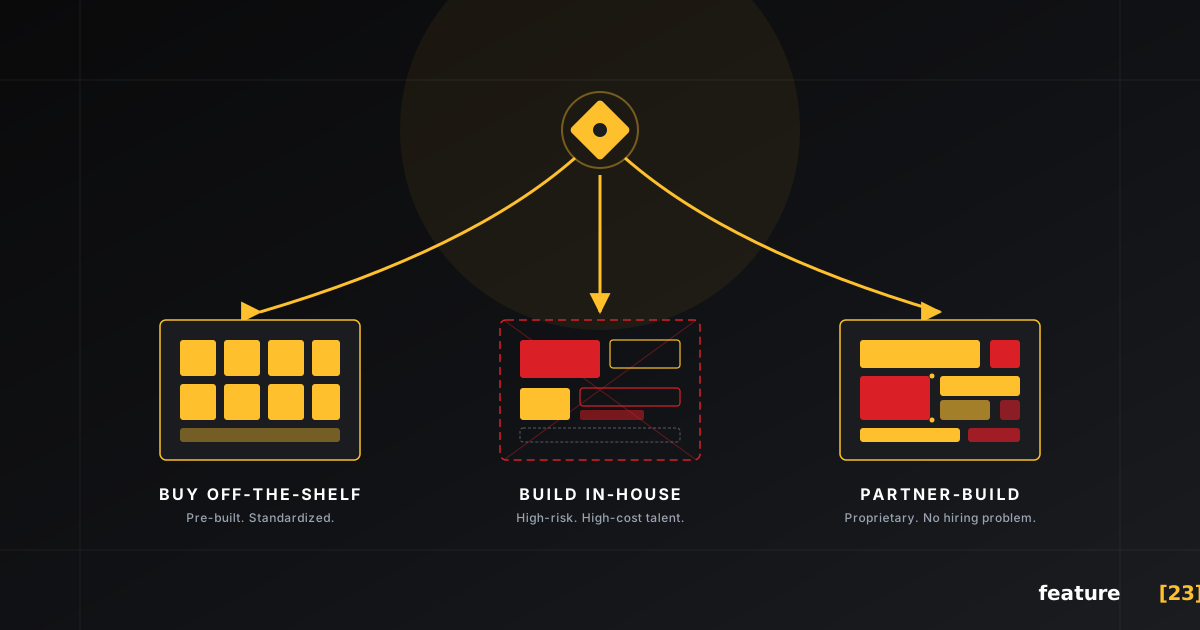 May 12, 2026 Build vs Buy Software: A Practical Decision Framework (2026) You don't need a 50-slide deck to make this call. You need to be honest about three things: what ... Read article →](https://www.feature23.com/insights/build-vs-buy-software)
[View All Articles](https://www.feature23.com/insights)
## Take the next steps toward digital success.
Ready to turn challenges into opportunities? Let’s make it happen—together.
[Contact us to find out how](https://www.feature23.com/contact)
[Services](https://www.feature23.com/services) [Careers](https://www.feature23.com/careers) [Our Work](https://www.feature23.com/case-studies) [Insights](https://www.feature23.com/insights) [Contact](https://www.feature23.com/contact)
[LinkedIn](https://www.linkedin.com/company/feature23)
© 2008 - 2024 feature\[23\]. All rights reserved.
[Privacy Policy](https://www.feature23.com/privacy-policy)
```json
{
"@context" : "https://schema.org",
"@type" : "BlogPosting",
"author" : {
"@type" : "Person",
"name" : "Mike Potts",
"url" : "https://www.feature23.com/insights/author/mike-potts"
},
"dateModified" : "2026-08-18T14:19:06.662Z",
"datePublished" : "2026-08-18T14:19:06.000Z",
"headline" : "The Better AI Strategy: Extend Before You Replace",
"image" : [ "https://www.feature23.com/hubfs/blog/add-ai-to-existing-systems/cover-v5.svg" ],
"mainEntityOfPage" : {
"@id" : "https://www.feature23.com/insights/ai-strategy-extend-before-you-replace",
"@type" : "WebPage"
},
"publisher" : {
"@type" : "Organization",
"logo" : {
"@type" : "ImageObject",
"url" : "https://www.feature23.com/hubfs/f23-logo-white-with-gold.svg"
}
}
}
```