![feature[23] white and gold logo](https://www.feature23.com/hubfs/f23-logo-white-with-gold.svg "feature[23] white and gold logo")
.jpeg)
Executive Summary
Middle-market companies routinely outgrow the systems that powered their early success. The consequences are strategic: constrained growth, compressed margins, opaque decision-making and mounting compliance risk. This guide provides a practical framework for evaluating whether legacy system modernization is warranted, what it costs, what can go wrong and how to sequence the work. It draws on real-world examples from insurance, health care supply chain, food distribution and consumer packaged goods.
The Growth Problem Nobody Budgets For
Growth has a way of revealing what your systems can’t do. The ERP that handled operations smoothly at $20 million in revenue starts to buckle under the weight of a $75 million business. Reports that once took minutes now require hours of manual reconciliation. Workarounds multiply. Teams spend more time managing their tools than managing the business.
This is the reality of legacy systems — and it’s more common in the middle market than most executives care to admit. According to a 2024 MuleSoft connectivity report, the average enterprise now uses more than 1,000 applications, yet only 29% of them are integrated. For middle-market companies with smaller IT budgets, the fragmentation is often worse and the consequences more acute.
The challenge isn’t that the software is old. The challenge is that it no longer aligns with where the company is headed. The real risks aren’t technical. They’re strategic: constrained revenue growth, compressed margins, poor decision visibility and regulatory exposure that compounds over time.
This guide is written for the executive who suspects the business has outgrown its systems but needs a practical framework before committing capital. It covers what legacy system modernization involves, when it’s worth pursuing, what it costs, what can go wrong and how to sequence the first 90 days.
What Is Legacy System Modernization?
What Exactly Is a Legacy System?
In boardroom shorthand, “legacy system” often gets used interchangeably with “old system.” That’s a misleading equivalence. A system doesn’t become legacy because it was built 15 years ago. It becomes legacy when it can no longer keep pace with the business it’s supposed to support.
A legacy system is any core business platform that cannot scale with growth, requires persistent manual workarounds, produces inconsistent or unreliable reporting, resists integration with other tools and creates operational drag across the organization. A five-year-old CRM that forces your sales team into spreadsheets qualifies every bit as much as a mainframe from the 1990s. The defining characteristic isn’t age. It’s misalignment with the business.
What Does Modernization Actually Mean?
In practice, legacy system modernization can include replacing high-risk platforms entirely, digitizing manual workflows, integrating fragmented tools into a unified architecture, re-architecting systems for scalability, improving the integrity of financial and operational reporting, and enabling operational leverage across business units.
The important framing for any executive: modernization is about improving how the business operates and competes. It is not about upgrading technology for its own sake. If the initiative doesn’t connect to revenue growth, margin improvement, risk reduction or competitive positioning, it’s not modernization. It’s a technology project — and the distinction matters when you’re allocating capital.
Why Middle-Market Companies Stay on Legacy Systems
If legacy systems are so problematic, why do so many middle-market companies continue to run on them? The answer is rarely ignorance. Most leadership teams know their systems are holding them back. What keeps them in place is a combination of rational caution and organizational inertia.
The most common reasons include familiarity (“it still works”), fear of operational disruption, prior failed technology initiatives that burned credibility and budget, limited internal bandwidth to lead a transformation, legitimate cost concerns and the reality that internal IT teams are often optimized for maintenance rather than strategic change. Deloitte’s 2023 digital transformation survey found that 70% of digital initiatives fail to reach their stated objectives — a statistic that gives any prudent executive pause.
Here’s the key insight: legacy systems are often remarkably stable. That stability is precisely what makes them so difficult to move away from. But stability is not the same as scalability, and it is not the same as competitive advantage. A system can be perfectly reliable and still be the single biggest constraint on the next stage of growth.
The Real Business Risks of Legacy Systems
The cost of maintaining a legacy system is rarely limited to the line item in the IT budget. The real exposure is operational, financial and strategic.
Operational Drag
Legacy systems create friction at every level of the organization. When core workflows depend on spreadsheet overlays, duplicate data entry, manual approval chains and siloed databases, the cumulative effect is slower decision-making and higher overhead. ITIC’s 2024 reliability survey found that a single hour of server downtime now costs over $300,000 for 91% of mid-size and large enterprises — and that figure doesn’t account for the chronic drag of manual workarounds.
Margin Compression
Inefficiency is expensive, but it’s often invisible on the income statement. Legacy systems mask the true cost of operations through inefficient workflows, poor pricing visibility, hidden rework and lost productivity across departments.
“How much of our margin erosion is structural?” This is the question every middle-market executive should be asking — and the answer is almost always more than leadership expects.
Compliance and Reporting Risk
For companies in regulated industries — financial services, health care, insurance, government contracting — legacy systems can create existential exposure. Inconsistent data integrity, gaps in audit trails, difficulty producing accurate regulatory reports and a lack of traceability across systems all represent material risk. The cost of a compliance failure almost always dwarfs the cost of modernization.
Competitive Disadvantage
While your teams are managing workarounds, your competitors may be offering a better customer experience, faster onboarding and stronger data-driven decision-making. Legacy systems don’t just slow you down internally. They limit your ability to differentiate in the market and can erode enterprise value in the eyes of investors and acquirers.
Are Legacy Systems Still Reliable?
Yes. Many legacy systems are reliable. They run. They process transactions. They’ve been tested by years of use. This is worth stating directly because intellectual honesty matters in any capital allocation discussion.
But reliability is not the same as scalability, agility, competitive advantage or enterprise value growth. The question isn’t whether the system works. The question is whether it’s working for the business you’re building. Maintenance keeps the lights on. Modernization enables leverage.
Signs You Need Modernization vs. Better Maintenance
Not every system problem requires modernization. The following table can help executives distinguish between systems that need maintenance investment and those that have outgrown their capacity to serve the business.
| Signals You Need Modernization | Signals You Need Better Maintenance |
|
System cannot scale with planned growth
|
System is stable but needs patches or updates
|
|
Reporting is inconsistent or unreliable
|
Reports exist but need reformatting or cleanup
|
|
Regulatory compliance is at risk
|
Compliance is met but audit prep is manual
|
|
Persistent manual workarounds across teams
|
Occasional workarounds for edge cases
|
|
Integration with other tools is blocked
|
Integrations are possible but not yet built
|
|
Internal teams spend more time maintaining than building
|
IT team can handle both maintenance and improvements
|
|
Competitors are outpacing you digitally
|
Competitive position is stable for now
|
The Five Strategic Paths to Legacy System Modernization
Not all legacy software modernization efforts require tearing everything down and starting over. There are five well-established approaches, and the right one depends on the company’s objectives, risk tolerance and operational complexity.
|
Approach
|
Description
|
Best For
|
Risk Level
|
Timeline
|
|
Rehost
|
Move to new infrastructure (e.g., cloud) without redesign
|
Reducing infrastructure cost and risk
|
Low
|
3–6 months
|
|
Replatform
|
Targeted improvements while keeping core structure
|
Balancing modernization with limited disruption
|
Low–Medium
|
3–9 months
|
|
Refactor
|
Improve code and architecture for scalability
|
Systems with sound logic but poor structure
|
Medium
|
6–12 months
|
|
Rearchitect
|
Fundamental redesign of system structure
|
Businesses outgrowing current architecture
|
Medium–High
|
9–18 months
|
|
Replace
|
Build or adopt an entirely new system
|
Structural constraints or existential risk
|
High
|
12–24+ months
|
The executive takeaway: the question isn’t which approach sounds the most modern. It’s which approach aligns with business objectives and risk tolerance. In many cases, companies will use different approaches for different systems within the same initiative.
The Case for Extending Legacy Systems with AI
There's a growing assumption in the market that legacy systems and modern AI capabilities are incompatible — that the only path forward is replacement. That framing is too simple, and for many middle-market companies, it's the wrong starting point.
Many legacy systems contain something that rarely gets accounted for in modernization discussions: decades of accumulated business logic. Pricing rules, approval workflows, compliance conditions, edge case handling — decisions made years ago by people who have long since moved on, encoded into software that hasn't forgotten. This is precisely why large-scale rewrites so frequently fail. The challenge isn't writing new code. It's capturing 20 years of operational decisions with enough precision that nothing critical gets lost in translation.
AI-enabled integration offers a different path. Rather than replacing a legacy system wholesale, organizations can extend it — adding AI capabilities at the edges to improve decision-making, automate workflows and surface insights, while preserving the business logic the organization depends on. The legacy platform becomes the foundation; AI becomes the layer that makes it more capable.
For middle-market executives, the practical implication is this: before concluding that your legacy system needs to be replaced, ask whether it needs to be extended. In many cases, the smarter investment is enabling what you already have rather than rebuilding from scratch.
What Are the Risks of Legacy System Replacement?
Any honest discussion of modernization has to address what can go wrong. These are real risks, and they deserve direct treatment.
Business disruption. Legacy systems are core infrastructure. Replacing or significantly modifying them creates temporary instability that, if unmanaged, can erode the very value the initiative was designed to create.
Data migration risk. Years of accumulated data often carry quality problems that only surface during migration. Poor data hygiene, inconsistent formats and undocumented dependencies can complicate the transition significantly.
Cost overruns. Scope expansion, unclear objectives and vendor misalignment are the most common drivers. McKinsey research has found that large IT projects run 45% over budget and deliver 56% less value than projected on average. Disciplined governance is the best hedge.
Internal resistance. Change fatigue, competing priorities and confusion about ownership can undermine even well-conceived initiatives. If the people who use the systems every day don’t support the change, adoption will suffer.
The greatest risk isn’t modernization itself. It’s modernization without clearly defined business outcomes. When the objective is vague, every other risk compounds.
How Much Does It Cost to Maintain a Legacy System?
Executives often underestimate the true cost of legacy IT maintenance because the most significant expenses don’t appear on a single budget line. Analysts have estimated that up to 80% of IT budgets at established companies go toward maintaining existing systems rather than building new capabilities — capital that could otherwise be deployed toward growth.
|
Direct Costs (Visible)
|
Indirect Costs (Hidden)
|
|
Software licensing and subscription fees
|
Slower revenue growth from system constraints
|
|
Vendor support and maintenance contracts
|
Executive time managing workarounds
|
|
Infrastructure and hosting expenses
|
Poor decision visibility from unreliable reporting
|
|
Personnel dedicated to system maintenance
|
Increasing regulatory and compliance exposure
|
|
Hardware replacement and upgrade cycles
|
Inability to attract or retain technical talent
|
|
Security patching for aging platforms
|
Delayed product launches and market responsiveness
|
When companies account for both direct and indirect costs, the total is almost always higher than the budget line suggests. In many cases, it exceeds the cost of modernization itself.
Is Replacing a Legacy System Worth It?
This is a capital allocation decision, not a technology decision, and it deserves to be evaluated accordingly.
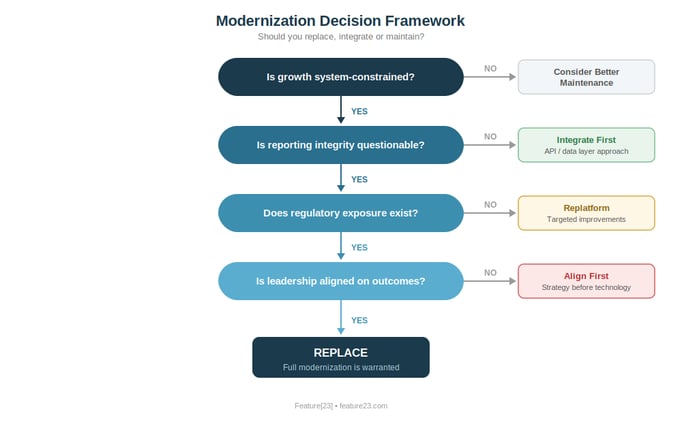
Replace when growth is system-constrained, when reporting integrity is questionable, when regulatory exposure exists, when internal teams are overloaded with maintenance at the expense of strategic work or when competitive pressure is accelerating.
Do not replace when business outcomes haven’t been clearly defined, when the broader business strategy is still unclear, when the initiative is driven by trend anxiety rather than operational need or when leadership is not aligned on the investment.
Modernization without strategic clarity produces expensive technology projects. Modernization as a deliberate capital allocation decision, with defined outcomes and disciplined governance, delivers measurable returns.
Legacy System Modernization in Practice
Theory is useful, but executives want to see how modernization plays out in the real world. The following examples from Feature[23]’s illustrate how middle-market companies identified system constraints, chose a modernization path and achieved measurable outcomes.
Digitizing a Global Supply Chain
Constraint: A global seafood distributor had outgrown its spreadsheet-driven workflows. Fisheries needed to upload compliance documents, internal teams lacked shipment visibility and a commercial kitchen required production scheduling that existing tools could not support.
Approach: Feature[23] built a custom operations platform including a fisheries compliance portal, shipment management, production scheduling and integrations with Salesforce and NetSuite.
Outcome: Reduced compliance risk, improved coordination across sourcing, logistics and production teams, and established infrastructure capable of supporting enterprise-scale distribution.
Consolidating Fragmented Systems Into a Unified Data Layer
Constraint: A national insurance brokerage had accumulated a patchwork of third-party platforms and internal tools across departments, resulting in inconsistent reporting and limited visibility into organization-wide performance.
Approach: Rather than replacing existing systems, Feature[23] built a centralized integration and data governance platform that connected disparate services into a cohesive data model.
Outcome: Reduced operational friction, improved reporting consistency and gave leadership a consolidated view of the business — proving that strategic integration, not wholesale replacement, can unlock significant value.
Enabling Mobile Field Operations at Scale
Constraint: A major U.S. cigar manufacturer needed to modernize field sales, inventory tracking and regulatory compliance workflows that were increasingly difficult to manage manually across multiple business units.
Approach: Feature[23] deployed an offline-enabled mobile sales application with AI-assisted price analysis, an excise tax and returns management system and a manufacturing verification scanner for international operations.
Outcome: Improved financial control over millions of dollars in inventory, modernized operations across sales, warehousing and production, and improved traceability within highly regulated tobacco workflows.
In each case, the pattern is the same: a specific business constraint drove the decision, the modernization approach was tailored to the operational reality and the outcome was measured in business terms.
What Good Modernization Looks Like
Executives rightly want to understand sequencing. A well-structured modernization effort follows a disciplined progression in its first quarter.
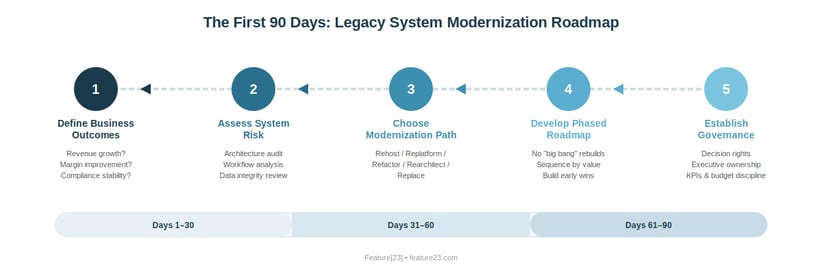
Step 1: Define business outcomes. Before evaluating any technology, the leadership team should align on what the modernization effort needs to accomplish. Is the priority revenue growth? Margin improvement? Operational visibility? Compliance stability? These outcomes shape every subsequent decision.
Step 2: Assess system risk. Conduct a thorough architecture audit, workflow analysis and data integrity review. The goal is to understand not just what the system does but where it creates risk and where it constrains growth.
Step 3: Choose the modernization path. Not every system requires full replacement. Based on the risk assessment and business objectives, determine which of the five strategic approaches best fits each system in scope.
Step 4: Develop a phased roadmap. Avoid the temptation of a “big bang” rebuild. Sequence the work so that each phase delivers incremental value while managing organizational risk. Early wins build credibility and momentum.
Step 5: Establish governance. Define clear decision rights, executive ownership, measurable KPIs and budget discipline from the outset. Modernization efforts that lack governance structures tend to drift, expand and ultimately underdeliver.
Trends Shaping Legacy System Modernization
Several trends are accelerating the urgency of legacy IT modernization for middle-market companies: cloud-native infrastructure reducing hosting costs, API-first architectures enabling integration without full replacement, AI-enabled workflows creating new automation opportunities, centralized data governance becoming a baseline expectation for institutional investors and security-first architecture becoming mandatory across industries.
These are contextual factors, not reasons to modernize in their own right. An executive’s job is to distinguish between what’s trending and what’s relevant to their specific business.
Frequently Asked Questions
What is the difference between legacy system modernization and digital transformation?
Legacy system modernization focuses specifically on upgrading or replacing the core business platforms that are constraining operations. Digital transformation is a broader term that encompasses organizational change, process redesign and technology adoption across the entire enterprise. Modernization is often a critical component of digital transformation, but it is more targeted in scope and more directly tied to specific system constraints.
How long does legacy system modernization take?
Timelines vary significantly depending on the approach. A rehosting effort can be completed in three to six months. A full system replacement for a complex, regulated business typically takes 12 to 24 months. Most middle-market modernization initiatives benefit from a phased approach that delivers incremental value in 90-day cycles rather than a single large-scale deployment.
What are the biggest mistakes companies make during modernization?
The most common mistakes are starting without clearly defined business outcomes, underestimating the complexity of data migration, failing to secure executive sponsorship and governance, and attempting to modernize everything at once rather than sequencing by priority and risk. Each of these can be mitigated with disciplined planning and experienced partners.
Can legacy systems be integrated with modern tools without full replacement?
Yes. In many cases, integration is the right first step. API-first architectures, middleware and custom integration layers can connect legacy systems with modern tools — unifying reporting and improving data flow without the risk and cost of full replacement. This is the approach Feature[23] took with Brightway Insurance, building a centralized data platform that connected existing systems rather than replacing them.
How do I know if my systems need modernization or just better maintenance?
If the system is stable, performs reliably and supports the business at its current scale, better maintenance may be sufficient. If the system cannot scale with planned growth, produces inconsistent reporting, creates compliance risk or requires persistent manual workarounds to function, those are signals of a modernization need — not a maintenance gap.
The Executive Self-Assessment
Before commissioning a roadmap or engaging a technology partner, every executive team should answer four questions honestly:
-
Is this system helping us scale — or constraining our growth?
-
Does it give us reliable visibility into how the business is performing?
-
Is it protecting us from risk — or exposing us to it?
-
Is it creating competitive advantage — or quietly eroding it?
If the answers point to constraint rather than capability, modernization deserves serious executive attention. If they point to capability, the smartest move may be to invest elsewhere.
The Bottom Line
Legacy system modernization is not a technology initiative. It is an operational decision with direct implications for growth, margin, risk and enterprise value.
The companies that modernize successfully treat it as a capital allocation exercise. They define business outcomes before evaluating platforms. They choose modernization paths based on risk tolerance and strategic objectives. They govern the work with the same discipline they apply to any other material investment.
And they hold themselves to a clear standard: if a modernization effort can’t be tied to measurable business outcomes — reduced risk, increased visibility, improved operational performance — it shouldn’t be done. The benchmark for action isn’t whether the technology is outdated. It’s whether the investment will make the business stronger.
Ready to Evaluate Your Systems?
Feature[23] partners with middle-market companies to assess legacy system risk, define business-aligned modernization strategies and build custom software that supports the next stage of growth. If your leadership team is weighing a modernization decision, we’d welcome the conversation.