![feature[23] white and gold logo](https://www.feature23.com/hubfs/f23-logo-white-with-gold.svg "feature[23] white and gold logo")
Build vs Buy Software: A Practical Decision Framework (2026)
You don't need a 50-slide deck to make this call. You need to be honest about three things: what the software has to do, what it's worth to your business if it works, and whether your team can actually run it once it exists.
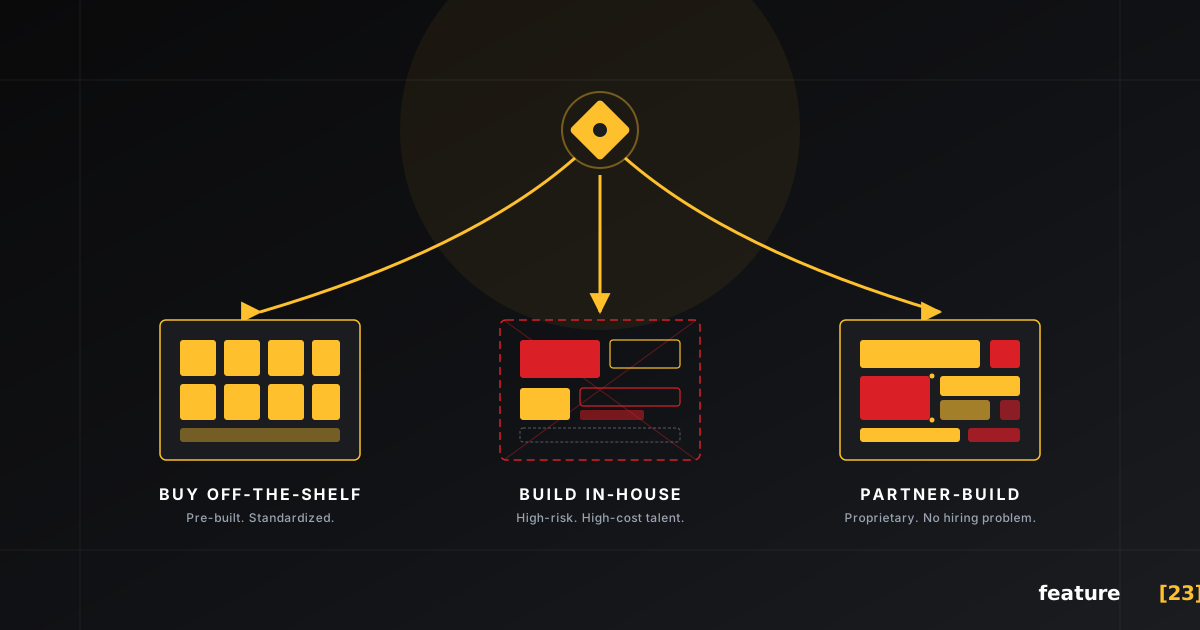
Most build vs buy software debates get stuck because they treat the decision like a binary. It isn't. There are three real options: buy off-the-shelf, build in-house, or partner with an engineering firm to build something proprietary. Each is the right answer in different situations, and choosing the wrong one is expensive in different ways.
Three Options, Not Two
The classic build vs buy framing leaves out the option most mid-market companies actually need. You can:
- Buy off-the-shelf. A SaaS product or commercial system that fits your process well enough.
- Build in-house. Hire and run an engineering team that owns the software start to finish.
- Partner-build. Work with an outside engineering firm to design and build proprietary software you own, with a smaller (or no) internal engineering team.
The mistake is comparing #1 and #2 and forgetting #3 exists. For most $50M–$500M operators, partner-build is the realistic middle path between buying something that doesn't quite fit and committing to a long-term hiring problem.
When Buying Is the Right Call
Buy off-the-shelf when your problem looks like a thousand other companies' problems. Payroll. Email. Standard accounting. Core CRM. The vendors in these categories have spent more than you ever will. You won't out-build them, and you shouldn't try.
The trouble starts when off-the-shelf is sold as a fit for a process that isn't actually standard. According to Gartner Digital Markets, 68% of fast-growing businesses regret a software purchase, and 31% have already replaced software because it cost too much (Gartner, 2024). Most of that regret isn't about the sticker price. It's about the customization work, the integrations, the workarounds, and the team time spent forcing the platform to behave like your business.
If you're sketching a six-figure customization plan around a SaaS product, that's a signal. You're about to pay custom-software money for software you don't own.
When Building In-House Makes Sense
Building makes sense when the software is part of your competitive advantage, not a commodity utility. If the way you route service calls, underwrite policies, manage inventory, or coordinate field crews is how you win, then a generic product flattens you into the same shape as your competitors.
The honest version of the in-house math: a senior software engineer in the US carries a median wage of $130,160 (U.S. Bureau of Labor Statistics, 2024). Call it ~$200K fully loaded. You need three or four of them to build anything serious, plus a tech lead and someone who can actually run the team. That's a $1M–$1.5M annual run-rate before you've shipped a feature. And tech turnover sits at roughly 13.2%, the highest of any industry, so the team is also rebuilding itself every couple of years.
If you can absorb that and keep it staffed, in-house is great. Most regional and multi-regional mid-market operators genuinely can't, usually because of geography or local talent market, not budget. That's where the third option comes in.
When Partner-Build Is the Answer
Partner-build is the right call when the software has to be proprietary but a permanent in-house team isn't realistic. It works because the partner takes on the talent problem, the methodology, and the senior engineering bench, and you still own the result.
The tradeoff: you're paying for senior engineering, not commodity hours. US onshore firms typically charge $100–$300/hour (Clutch, 2026), and a meaningful custom build runs six to seven figures. That sounds expensive until you compare it to running an in-house team, or to the real cost of buying the wrong off-the-shelf platform and replacing it eighteen months later.
The thing partner-build buys you that the other two options don't: continuity without the hiring problem. The same team that scopes the work also builds it, and is still around when you need version two.
A Decision Rule You Can Actually Use
Three questions, in order:
- Is this software a commodity, or is it part of how we compete? If commodity, buy.
- If it's part of how we compete, can we realistically staff a senior engineering team to own it long-term? If yes, build in-house. If no, partner-build.
- Before any of that, do we actually understand the problem well enough to scope it? If you can't answer that cleanly yet, a short discovery engagement is usually the highest-impact dollar you'll spend.
Most failed software investments don't fail at the build stage. They fail at the decision stage: buying a tool that doesn't fit, hiring a team you can't keep, or briefing a partner with a spec that was wrong before anyone wrote a line of code.
Frequently Asked Questions
Is custom software always more expensive than off-the-shelf?
Not always. Off-the-shelf has lower up-front cost but adds recurring license, integration, and customization spend. Custom software has higher up-front cost but no per-seat fees and no platform you don't control. For software central to how you operate, custom often wins on five-year TCO, especially when SaaS waste runs around $21M a year at the average company (Zylo, 2025).
What are the real disadvantages of custom software?
Higher up-front investment, longer time-to-value (typically 6–18 months vs. weeks for SaaS), and the need to maintain it. If you don't own the maintenance plan up front, custom software degrades into legacy software faster than most teams realize. Any build vs buy software analysis that ignores ongoing ownership is incomplete.
How do we know if our problem is commodity or competitive?
A useful test: would you describe how you do this in a job listing as "standard for the industry" or "the way we win"? Standard means buy. The way we win usually means build. Most build vs buy enterprise software decisions come down to this one question.
What's the cheapest way to de-risk a build decision?
A short discovery engagement before the build. The cost is small (typically $50K–$100K) compared to the cost of building the wrong thing or buying the wrong platform. Most software projects that fail were already failing before code was written.
The Bottom Line
Build vs buy software isn't one question. It's three. What kind of problem is this, what kind of team can you actually run, and do you understand the work well enough to scope it. Get those right, and the build vs buy decision usually answers itself. Get them wrong, and it doesn't matter which option you pick. You'll be replacing it inside two years.