---
title: Why R&D Is Essential for Technology Enabled Business Transformation
description: Why disciplined R&D is what makes digital transformation pay off for middle-market companies, and how to run it without betting the budget.
image: https://www.feature23.com/hubfs/raw_assets/public/f23-2025/images/og-image/f23-outperform.jpg
---
[Skip to main content](https://www.feature23.com/insights/why-rd-is-essential-for-technology-enabled-business-transformation#main-content)
[![feature\[23\] white and gold logo](https://www.feature23.com/hubfs/f23-logo-white-with-gold.svg "feature[23] white and gold logo")](https://feature23.com)
- [AI Engineering](https://www.feature23.com/ai-engineering)
- [Services](https://www.feature23.com/services)
- [Careers](https://www.feature23.com/careers)
- [Our Work](https://www.feature23.com/case-studies)
- [Insights](https://www.feature23.com/insights)
- [Contact us](https://www.feature23.com/Contact)
- [linkedin](https://www.linkedin.com/company/feature23)
- [Instagram](https://www.instagram.com/feature23)
- [twitter](https://twitter.com/feature23)
- [Privacy Policy](https://www.feature23.com/privacy-policy)
[Skip to content](https://www.feature23.com/insights/why-rd-is-essential-for-technology-enabled-business-transformation#main-content)
[![feature\[23\] white and gold logo](https://www.feature23.com/hubfs/f23-logo-white-with-gold.svg "feature[23] white and gold logo")](https://feature23.com)
- [AI Engineering](https://www.feature23.com/ai-engineering)
- [Services](https://www.feature23.com/services)
- [Our Work](https://www.feature23.com/case-studies)
- [Insights](https://www.feature23.com/insights)
- [Careers](https://www.feature23.com/careers)
- [Contact](https://www.feature23.com/contact)
# Why R&D Is Essential for Technology Enabled Business Transformation
[feature\[23\]](https://www.feature23.com/insights/author/feature23) Mar 5, 2026, 4:22:09 PM
## Every Company Is Becoming a Tech Company
Not long ago, a middle-market services firm could compete on relationships, operational excellence, and industry expertise alone. Technology supported the business. It didn't define it.
That era is over. Research shows that [92% of companies expect digitalization to fundamentally change their business models](https://www.pwc.com/us/en/services/consulting/business-transformation/digital-supply-chain-survey.html), and organizations with mature digital capabilities are 23% more profitable than their peers. Technology is no longer a supporting function — it is increasingly the operating backbone of the firm.
Today, clients expect digital interfaces. Competitors are embedding automation into their cost structures. AI is reshaping margins, response times, and customer expectations. What was once a "traditional" service business is now under pressure to operate like a technology-enabled platform.
And for many middle-market companies, this shift is happening fast.
Leaders who never had to think like software executives are suddenly making decisions about data architecture, AI use cases, internal tooling, and digital customer experience. They are investing in custom platforms, experimenting with AI pilots, and hiring technical teams — often for the first time.
The problem is not ambition. The problem is capability.
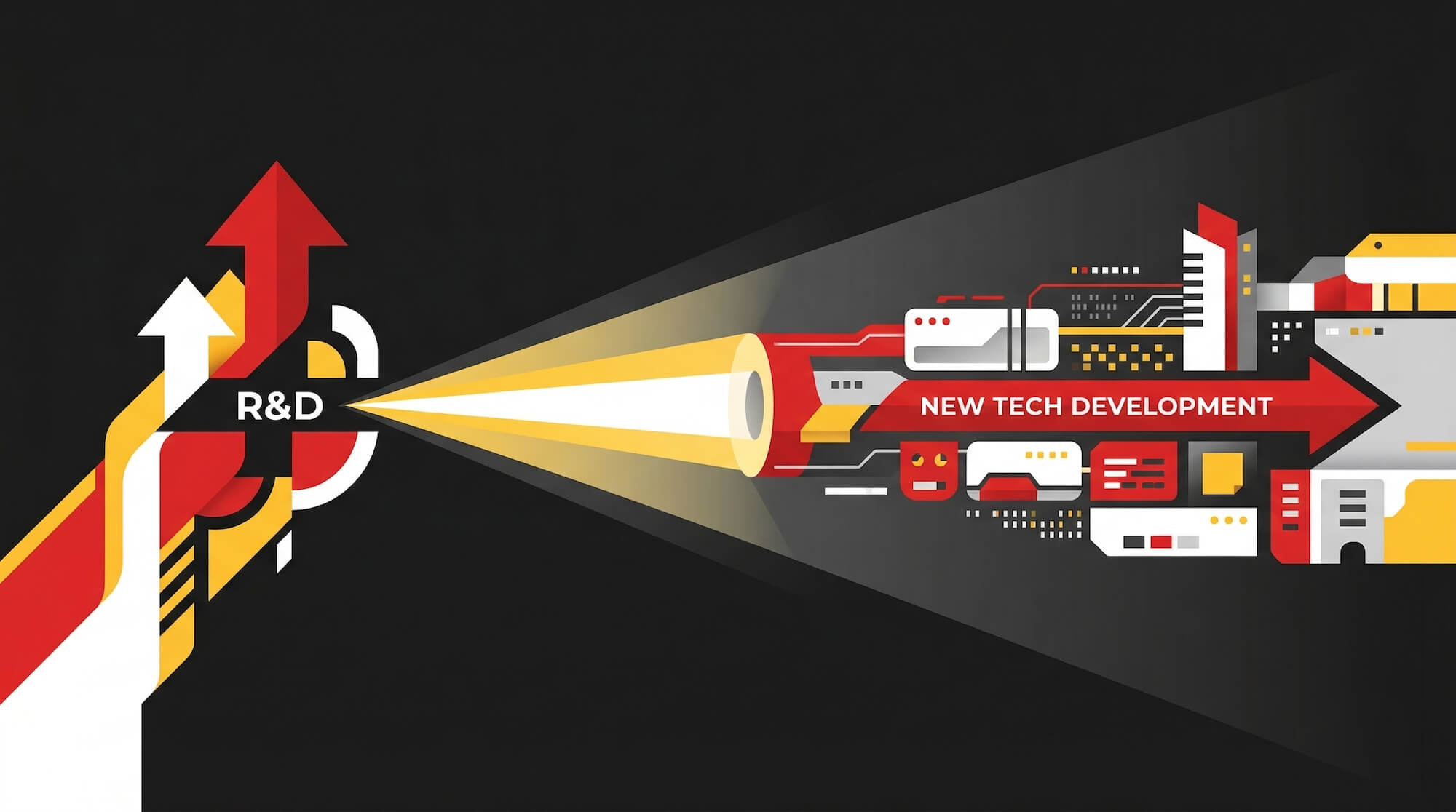
Becoming a 'Tech-Enabled Operator' is not about deploying more tools. It is about governing technology with discipline. Testing assumptions. Allocating capital with intent. Evolving systems in alignment with real business outcomes.
In other words, it requires R&D.
In a fiercely competitive landscape, R&D is no longer reserved for product companies. It is the foundation of digital capability and the mechanism that turns transformation from risk into return.
## The Failure Pattern: Building Without Learning
When pressure to digitize mounts, most middle-market companies respond the same way.
They commission a platform. They hire a development team. An AI initiative gets greenlit. A transformation roadmap is launched.
Activity accelerates. Budgets move. Roadmaps get built. But one critical step is often missing: structured learning.
Recent research from Boston Consulting Group highlights the scale of the challenge: while most companies are investing aggressively in AI, [74% still struggle](https://www.bcg.com/press/24october2024-ai-adoption-in-2024-74-of-companies-struggle-to-achieve-and-scale-value) to move beyond pilots and capture measurable value at scale. The gap is rarely technological capability. It is organizational discipline — the ability to translate experimentation into operational impact.
In the rush to modernize, companies skip disciplined research and move straight to implementation. Assumptions about customer behavior, workflow friction, cost drivers, or data readiness go untested. Technology decisions get made before the underlying problem is clearly defined.
| ***The result isn't digital transformation. It's digital accumulation: new systems layered on old assumptions, complexity added without clarity.*** |
| --- |
Systems get layered on top of legacy processes without addressing root inefficiencies. AI tools are deployed against poorly scoped use cases. Custom platforms hard-code flawed assumptions into the operating model. What began as an effort to modernize becomes a growing stack of technical and operational debt.
From the outside, it looks like progress. Internally, complexity increases. Flexibility decreases. ROI becomes harder to measure.
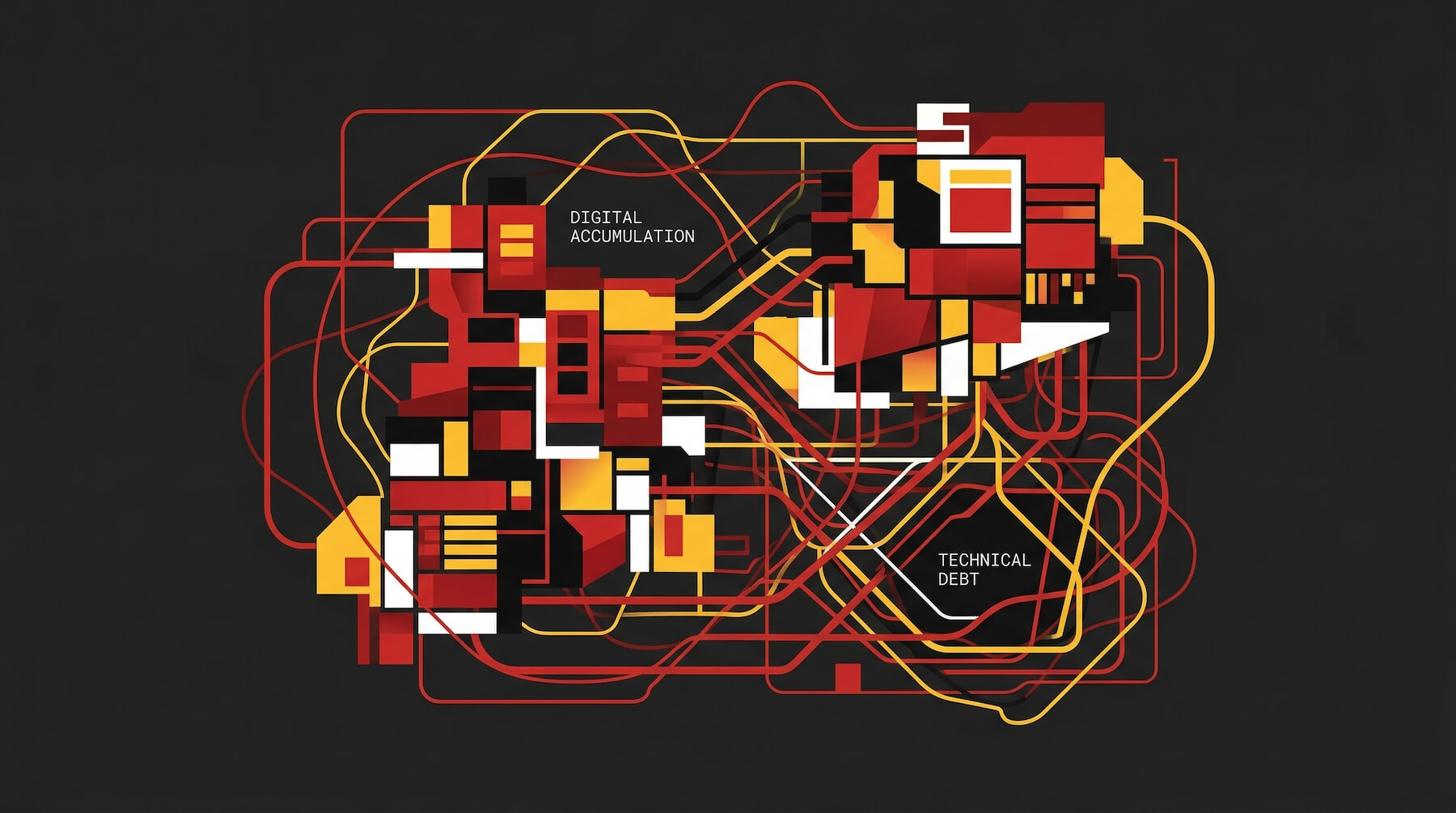
This is not a technology failure. It's a learning failure.
Companies scale before they reduce uncertainty. And in digital environments, scaling the wrong assumption turns a small mistake into a structural one.
## R&D as a Digital Risk Management Function
If digital transformation increases both opportunity and uncertainty, then R&D becomes the mechanism that manages both.
At its core, R&D is not about experimentation for its own sake. It is a structured approach to reducing uncertainty before capital is scaled. It is the discipline of testing assumptions before they become infrastructure.
In traditional industries, risk was often operational: supply chains, labor, pricing volatility. In digital environments, risk shifts upstream. It lives in architecture decisions, data strategy, use case selection, automation design, and AI deployment.
These decisions compound. A poorly chosen platform can shape workflows for years. A misaligned AI initiative can redirect talent and capital away from higher-leverage opportunities. A prematurely scaled system can lock in inefficiencies at digital speed.
Consider a firm that invests seven figures in a custom AI workflow tool, only to discover later that the real bottleneck was process design, not intelligence. Without structured R&D, the organization scaled the wrong solution and embedded it into daily operations.
R&D prevents flawed assumptions from becoming infrastructure. It forces clarity before scale, isolates variables before integration, and validates impact before rollout.
| **💡 Key Insight** R&D increases the expected value of every digital dollar spent — not by eliminating risk, but by ensuring that risk is intentional, contained, and economically rational. |
| --- |
For middle-market companies, this distinction is critical. Unlike large enterprises, they don't have the luxury of absorbing repeated large-scale digital failures. Each misstep carries disproportionate weight.
In an AI-enabled economy, that discipline is not optional. It is a competitive advantage.
## R&D Doesn't Slow You Down. It Accelerates ROI.
The most common resistance to investing in R&D during digital transformation is simple: "We don't have time."
Competitive pressure is real. Margins are tightening. AI capabilities are advancing quickly. No leadership team wants to be caught flat-footed while competitors automate, optimize, and modernize.
Research can feel like delay. But in digital strategy, speed without validation is rarely acceleration. It is amplification.
When companies skip structured R&D, they don't move faster. They move faster in the wrong direction. They scale untested assumptions, hard-code incomplete problem definitions, and integrate tools before proving impact.
At small scale, these issues are manageable inefficiencies. At enterprise scale, they become architectural constraints that are expensive to unwind.
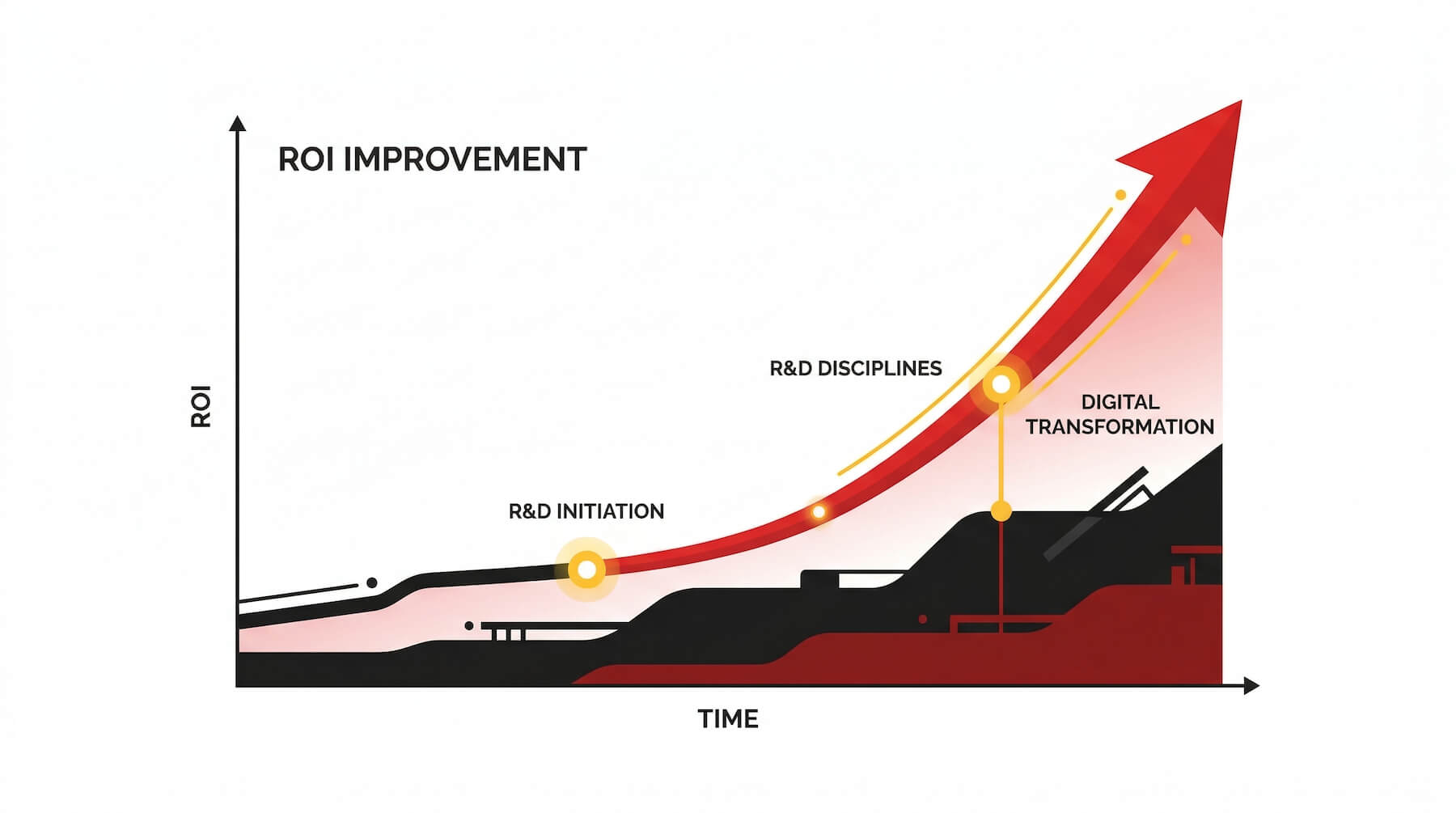
Properly structured R&D compresses timelines to meaningful ROI because it narrows the field of uncertainty early. Instead of spending 18 months building a solution only to discover adoption friction or weak impact, organizations identify the highest-leverage intervention before heavy capital is deployed.
| *R&D is not a drag on momentum. It is a multiplier on capital efficiency.* |
| --- |
A modest investment in disciplined experimentation can prevent years of rework. It can redirect millions in technology spend toward higher-yield initiatives. And in many cases, it reveals that a simpler operational adjustment — not a complex AI build — delivers the greatest return.
The companies that appear to move fastest in digital transformation are rarely guessing. They are learning faster than their competitors. And that speed comes from R&D.
## R&D Is Not a Phase. It's How You Operate.
Many companies treat R&D as something that happens at the start of a digital initiative — a discovery sprint before the "real work" begins.
But digital systems don't stabilize after launch. They evolve. AI models improve. Customer expectations shift. Competitors introduce new capabilities. Internal workflows adapt and costs move. Over time, assumptions age.
If research stops once a system goes live, learning stops, and complexity compounds.
Digital capability isn't built through a single successful deployment. It's built through continuous refinement. That requires R&D to function as an embedded operating discipline, not a temporary project phase.
For middle-market companies especially, this shift is critical. When digital transformation is treated as a one-time initiative, organizations default to reactive behavior, layering new tools onto old assumptions instead of strengthening the system underneath.
When R&D is institutionalized, the dynamic changes. It becomes part of how capital is allocated and how decisions are made. In practice, that means:
- **Disciplined use case selection** before engineering resources are committed
- **Contained experimentation** to validate business impact before scale
- **Regular assumption audits** to prevent outdated logic from hard-coding into systems
- **Clear economic alignment** between digital initiatives and measurable outcomes
In this model, research isn't optional overhead. It is governance. It ensures technology compounds value instead of complexity. And it institutionalizes learning as a competitive advantage.
In an economy where every company is becoming technology-enabled, learning speed is strategic advantage.
## What Kind of Company Are You Becoming?
Digital transformation isn't just about technology. It's about identity.
As middle-market firms digitize, they face a choice: bolt technology onto a traditional operating model, or evolve into an organization that manages technology with discipline.
The difference is not tools. It's governance.
Companies that treat digital investments as isolated projects will continue reacting to pressure. Those that institutionalize R&D build the capability to navigate uncertainty deliberately.
Over time, that capability compounds. Decisions improve. Capital allocation sharpens. Systems evolve instead of calcify.
In an AI-enabled economy, every company is becoming a technology company whether it intends to or not. The real question isn't whether you adopt AI. It's whether you build the operating discipline to manage it.
R&D is not an expense. It is the operating discipline that ensures digital capability becomes advantage rather than liability.
### Related Reading
- [Legacy System Modernization: A Practical Guide for Middle-Market Executives](https://www.feature23.com/insights/legacy-system-modernization)
- [Digital Platform Strategy: A Middle Market Guide](https://www.feature23.com/insights/digital-platform-strategy)
- [Why Most Mid-Market Software Projects Fail Before Anyone Writes Code](https://www.feature23.com/insights/why-mid-market-software-projects-fail)
[System Transformation](https://www.feature23.com/insights/tag/system-transformation)
From The Blog
## Recent Insights
### [ August 18, 2026 The Better AI Strategy: Extend Before You Replace I keep ending up in the same conversation. An executive team has been shown a slide deck by ... Read article →](https://www.feature23.com/insights/ai-strategy-extend-before-you-replace)
### [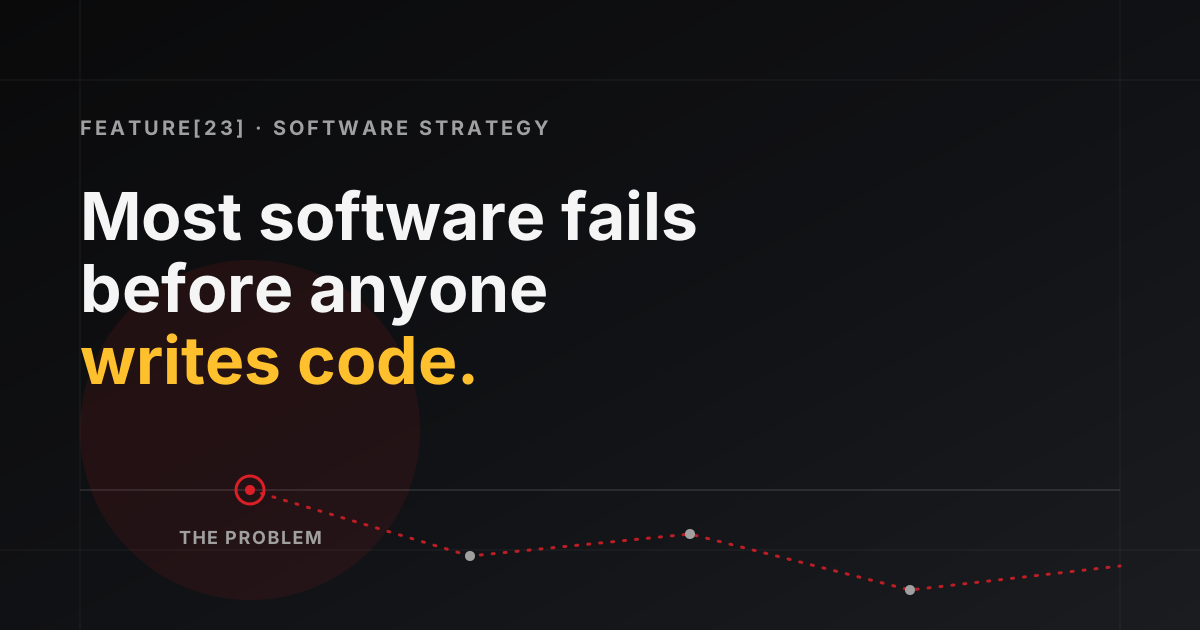 June 22, 2026 Why Most Mid-Market Software Projects Fail Before Anyone Writes Code I've been building custom software for middle-market companies since 2008, and I'll tell you the ... Read article →](https://www.feature23.com/insights/why-mid-market-software-projects-fail)
### [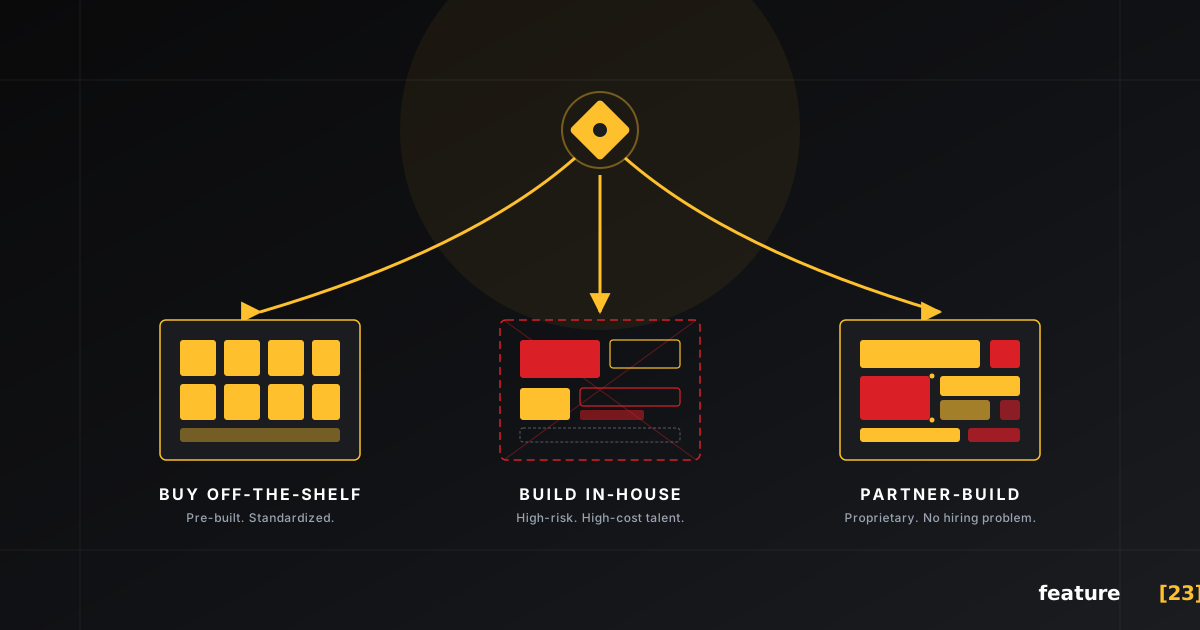 May 12, 2026 Build vs Buy Software: A Practical Decision Framework (2026) You don't need a 50-slide deck to make this call. You need to be honest about three things: what ... Read article →](https://www.feature23.com/insights/build-vs-buy-software)
### [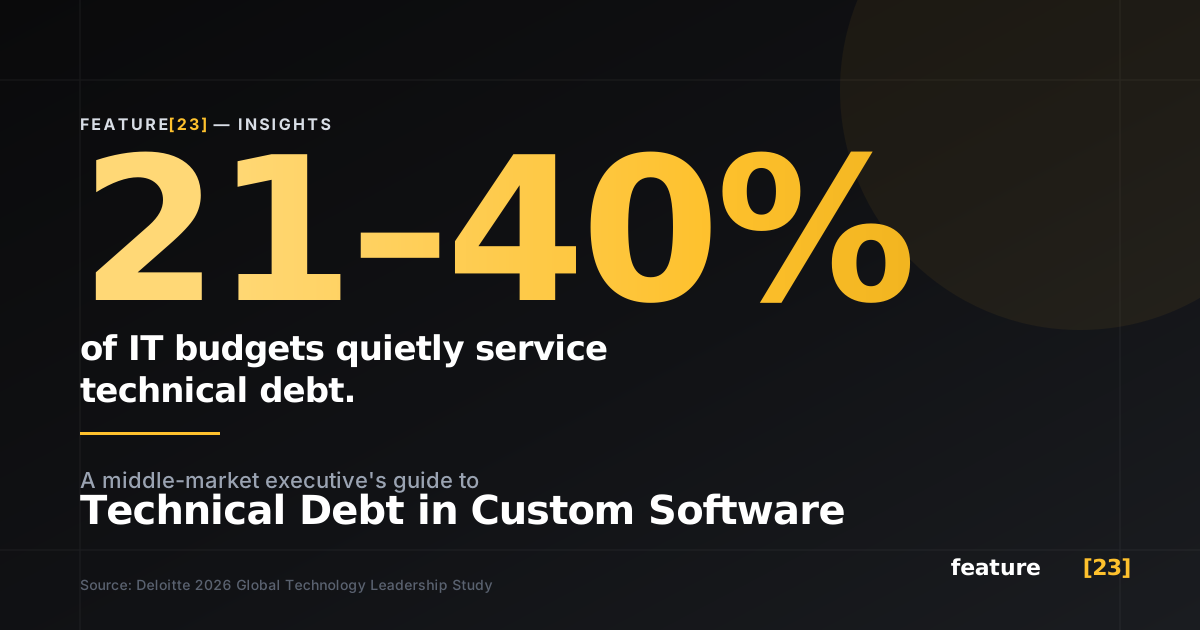 April 23, 2026 Technical Debt in Custom Software: A Middle-Market Executive's Guide Engineering says "we need to refactor." Delivery is slowing down. Every deploy seems to require a ... Read article →](https://www.feature23.com/insights/technical-debt-custom-software-middle-market-guide)
[View All Articles](https://www.feature23.com/insights)
## Take the next steps toward digital success.
Ready to turn challenges into opportunities? Let’s make it happen—together.
[Contact us to find out how](https://www.feature23.com/contact)
[Services](https://www.feature23.com/services) [Careers](https://www.feature23.com/careers) [Our Work](https://www.feature23.com/case-studies) [Insights](https://www.feature23.com/insights) [Contact](https://www.feature23.com/contact)
[LinkedIn](https://www.linkedin.com/company/feature23)
© 2008 - 2024 feature\[23\]. All rights reserved.
[Privacy Policy](https://www.feature23.com/privacy-policy)
```json
{
"@context" : "https://schema.org",
"@type" : "BlogPosting",
"author" : {
"@type" : "Person",
"name" : "feature[23]",
"url" : "https://www.feature23.com/insights/author/feature23"
},
"dateModified" : "2026-03-05T21:27:47.428Z",
"datePublished" : "2026-03-05T21:22:09.000Z",
"headline" : "Why R&D Is Essential for Technology Enabled Business Transformation",
"image" : [ "https://www.feature23.com/hubfs/image-1772741537656.jpg" ],
"mainEntityOfPage" : {
"@id" : "https://www.feature23.com/insights/why-rd-is-essential-for-technology-enabled-business-transformation",
"@type" : "WebPage"
},
"publisher" : {
"@type" : "Organization",
"logo" : {
"@type" : "ImageObject",
"url" : "https://www.feature23.com/hubfs/f23-logo-white-with-gold.svg"
}
}
}
```