![feature[23] white and gold logo](https://www.feature23.com/hubfs/f23-logo-white-with-gold.svg "feature[23] white and gold logo")
The Workaround Tax: What Off-the-Shelf Software Is Really Costing You
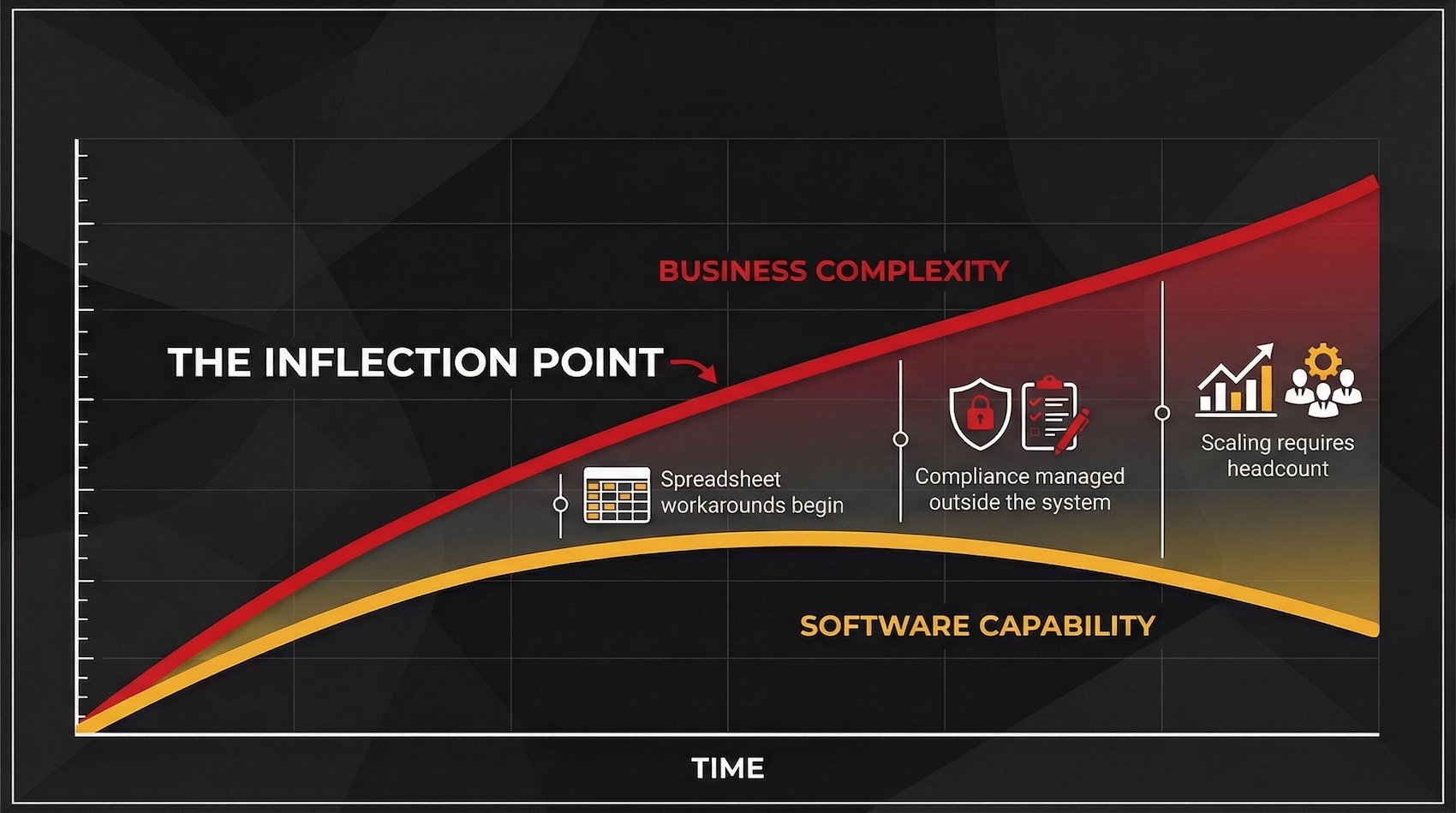
Every growing company hits the same quiet inflection point.
The software that once felt like a solution starts to feel like a constraint. Spreadsheets multiply at the edges of your CRM. Your ops team builds manual bridges between systems that were never designed to talk to each other. Someone, somewhere, is exporting a CSV every Friday afternoon just to get a number that should be automatic.
This isn't a workflow problem. It's the workaround tax.
Mid-market companies, occupy a uniquely difficult position in the software landscape. They're too complex for the lightweight tools that work at the startup stage, but often too lean to absorb the cost and overhead of enterprise platforms. They're caught in the middle, and the off-the-shelf software market was largely not built for them.
The result is a slow accumulation of friction: workarounds that become habits, integrations that break, and teams spending meaningful time managing their tools instead of doing real work.
The Case for Off-the-Shelf (And Why It Eventually Breaks Down)
Off-the-shelf software works. It works well, under the right conditions.
When your processes are standard, your team is small, and speed of deployment matters more than precision fit, buying a ready-made solution is usually the right call. You can be up and running in days. The vendor handles maintenance. The price is predictable. There's nothing wrong with any of that.
The problem isn't off-the-shelf software. The problem is using it past its expiration date.
The average business now runs nearly 900 applications, with only 29% of them integrated.
For a mid-market company scaling its operations, that fragmentation is expensive. Teams adapt their behavior to accommodate the gaps. Processes get designed around what the software can do rather than what the business actually needs. The tool becomes the authority, and the company works around it.
That's the moment the trade-off flips.
The Workaround Tax
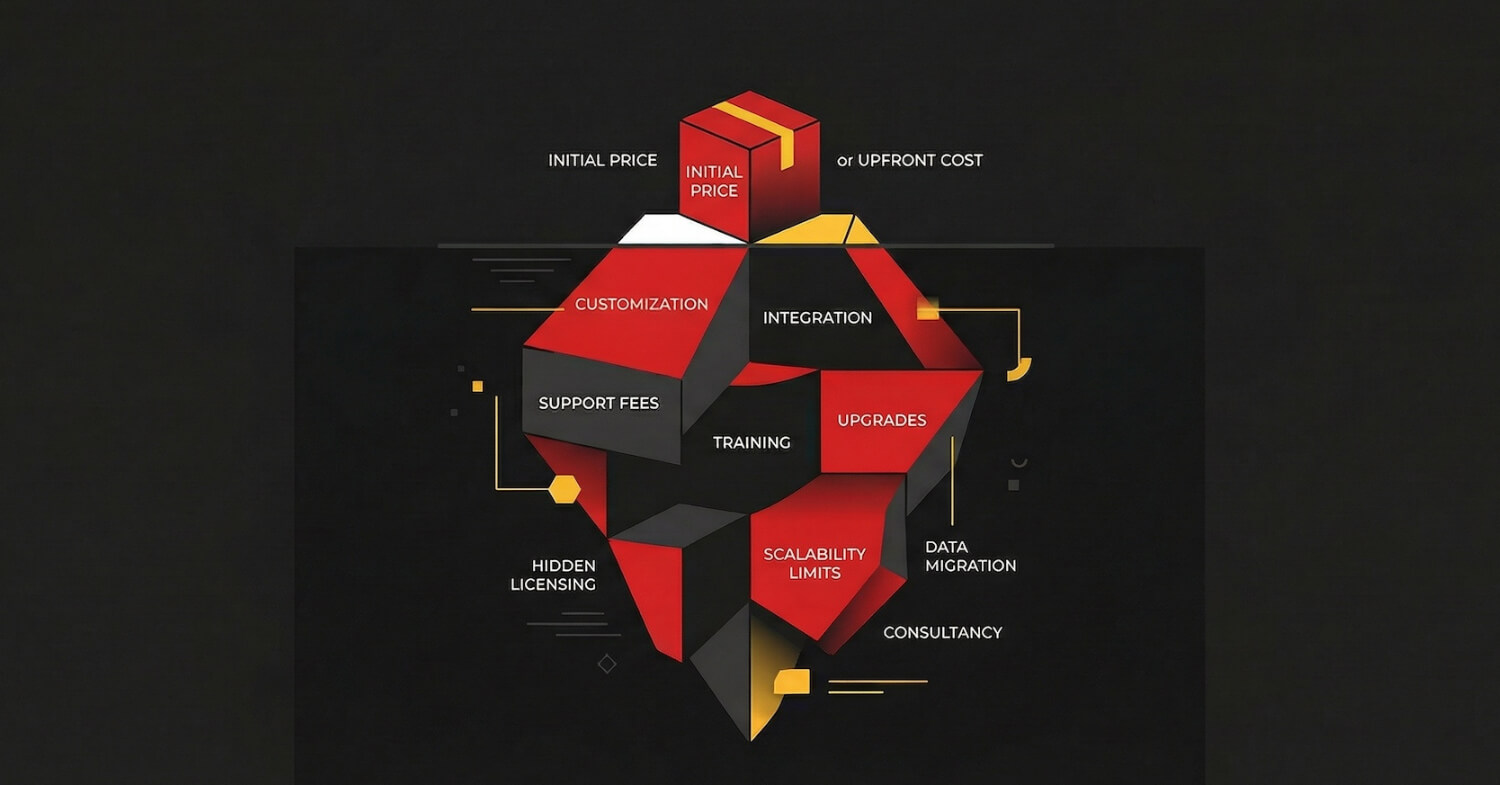
The cost of the workaround tax never shows up on your software invoice. So what is it exactly?
It's the hours your operations manager spends reconciling data between two systems that don't sync. It's the manual approval workflow someone built in a spreadsheet because your platform couldn't handle your specific exception logic. It's the onboarding doc that's twelve pages long because the software is so unintuitive that institutional knowledge is the only way to navigate it.
None of these costs are invisible. They're just distributed. They live in labor hours, in errors, in delayed decisions, and in the quiet frustration of capable people doing work that should be automated.
If your team is regularly exporting data, pasting it into spreadsheets, or re-entering information across multiple systems just to make a tool work, you're already paying for custom software. You're just paying for it in staff time, errors, and security risk.
The workaround tax compounds. What starts as a minor inconvenience becomes embedded process. And by the time it's visible enough to flag in a leadership meeting, it's been costing the business for years.
When the Tool Becomes a Ceiling
There's a second, less obvious problem with growing into the wrong software: it starts to constrain your strategy.
When your technology can't support a new business model, a new market, or a new regulatory requirement, you're not just dealing with an IT problem. You're dealing with a growth problem.
A Florida-based insurance company ran into exactly this. They were scaling quickly, writing new policies, expanding their agent network, and operating in one of the most heavily regulated insurance markets in the country. Their existing platform was a third-party system built for broad applicability. It worked fine, until it didn't.
As the company grew, the platform couldn't structure or report data in the specific formats required by state regulators. Reporting workflows became inconsistent. Confidence in core policy data began to erode. The gap between what the business needed and what the software could deliver wasn't a feature request. It was a structural mismatch.
The platform had been designed for generalized use across many markets. But this company operated in one specific market, with specific rules, specific workflows, and a specific pace of growth. The software was holding them back not because it was bad software, but because it was the wrong software.
They made the decision to build.
We partnered with them to design and implement a custom policy and underwriting platform, built from the ground up to reflect how the business actually runs, with a data architecture designed specifically for Florida's regulatory requirements. Within six months, the full platform migration was complete. No business disruption. One hundred percent of new policies transitioned to the new system. Reporting became reliable and auditable. The company now has a technology foundation built to scale with them, not against them.
The off-the-shelf platform wasn't a failure. It was the right tool for an earlier stage of the business. Custom software became the right tool for the next one.
Build vs. Buy: The Real Question
The build-vs-buy decision gets framed as a cost comparison. It shouldn't be.
The right question isn't "how much does it cost to build?" The right question is: is this process a competitive differentiator, or a commodity?
If the function is standard and the goal is speed, buy. Accounting software, basic CRM, internal messaging — there are excellent off-the-shelf options for all of these, and reinventing them wastes resources.
But when your processes are what make you different — when how you underwrite a policy, service a client, manage a production workflow, or deliver a product is genuinely unique — you're building competitive advantage on borrowed infrastructure. You're running your differentiation through software designed for everyone, which means it was designed for no one in particular.
For a mid-market firm, the break-even on custom software typically arrives around month 33, after which ongoing costs run lower than the stacked subscription and licensing overhead of off-the-shelf alternatives.
But the financial case often isn't the most important one. The more important case is operational: custom software compounds. It gets better as you build on it. Off-the-shelf software, at a certain stage of growth, just gets more expensive.
What Good Custom Development Actually Looks Like
The hesitation most executives have about custom software is understandable. The reputation is: expensive, slow, and risky. A year-long engagement. A six-figure overrun. A product that doesn't quite match what you asked for.
That reputation comes from real experiences, usually from engagements that lacked clear scope, clear ownership, or a development partner who understood the business problem before writing a line of code.
Done well, custom software development starts with constraints, not features. It's scoped to the 20% of functionality that drives 80% of the operational value. It's built iteratively, with working software in front of real users early and often. And it's measured against business outcomes: time saved, errors reduced, compliance maintained.
The insurance company mentioned earlier completed their full platform migration in six months. That timeline was possible because the scope was disciplined, the architecture was designed for their specific regulatory environment from day one, and the build process used AI-assisted development to accelerate delivery without sacrificing quality.
Speed and precision aren't in tension when the problem is understood correctly from the start.
A Simple Diagnostic
If you're unsure whether your current software stack is working for you or against you, start here.
Are your team members regularly working around the system to get their jobs done? Is your software vendor's roadmap driving your priorities instead of your own business strategy? Are you paying for features you don't use while still needing capabilities the platform doesn't have? Is integration between your critical systems manual, fragile, or both?
If two or more of those are true, you're likely already past the break-even point, paying a workaround tax that a well-scoped custom build would eliminate within the first year of operation.
The companies that get this decision right aren't necessarily the ones with the biggest technology budgets. They're the ones that are honest about where their processes are standard and where they're genuinely distinct, and they invest accordingly.
Off-the-shelf software is a good tool. It's just not always the right tool.
When your operations have outgrown what a general-purpose platform can support, building something that fits is the more practical choice and the more strategic one.
Feature[23] builds custom software for mid-market companies navigating exactly this transition. If you're evaluating whether your current stack is still the right fit, we'd be glad to think through it with you.
.jpeg)